
[Suwon = Edaily Reporter Hwang Young-min]
Domestic rice consumption in South Korea has shown a continuous decline, decreasing from 62.9 kg per person annually in 2015 to 55.8 kg last year. Compared to 110.2 kg in 1993, the figure has fallen by nearly half.
As consumption decreases, the amount of rice stored in warehouses continues to grow, yet there are limited ways to utilize it effectively. Rice stored for more than five years is rarely even used as animal feed, resulting in significant costs being wasted on storage and disposal.
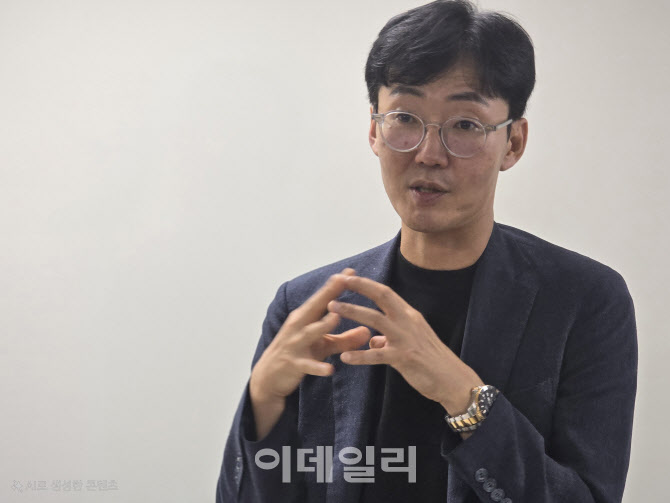
Park Jae-min is being interviewed by Edaily at the Gyeonggi Agricultural & Fisheries Promotion Agency on the 7th. (Photo = Reporter Hwang Young-min)
GRICO, a startup based in Gyeonggi-do that develops and manufactures biodegradable plastics, focused on discovering new uses for surplus rice. According to Park Jae-min, the company originally planned to develop a business extracting filler oil from surplus rice.
He explained,
“As we refined rice oil to produce filler oil, a large amount of by-products — commonly referred to as residue — was generated. While thinking about how to utilize it, we discovered that the German company BASF was developing biodegradable plastics. After visiting their factory, we decided to enter the field as well.”
After founding the company in 2023 under the name “Rice Farm,” Park Jae-min changed the corporate name to GRICO last year. The name “GRICO” combines the words Green, Rice, and Eco, reflecting the company’s commitment to producing carbon-neutral and naturally biodegradable eco-friendly products using surplus rice.
Unlike conventional plastics, which do not decompose naturally even after 100 years, the biodegradable plastics produced by GRICO fully biodegrade when exposed to microorganisms in ordinary soil or marine environments.
The company currently manufactures a wide range of products, including:
One of the company’s greatest strengths is its adjustable biodegradation period for each product. Park Jae-min stated,
“We possess technology that allows us to control the biodegradation period according to each product’s purpose — from as short as six weeks to more than three years.”
He also added,
“In the case of plastic wrap, we are currently collaborating with Kleen Wrap to improve transparency, which has been one of its biggest limitations.”
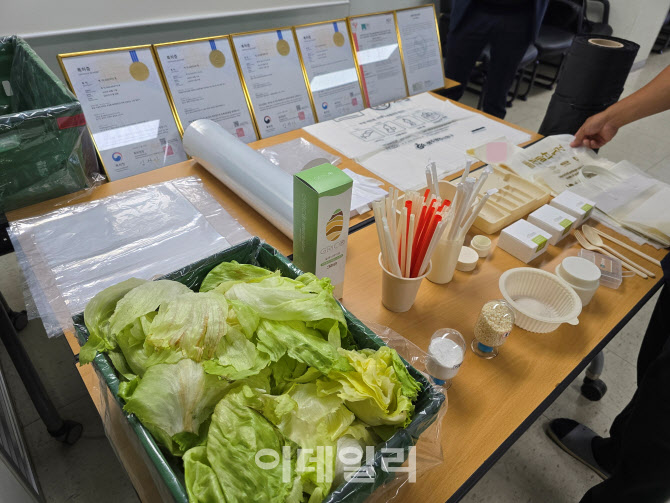
Biodegradable plastic products developed and produced by GRICO using rice as a raw material. (Photo = Reporter Hwang Young-min)
In terms of pricing, GRICO also maintains strong competitiveness. Since its products are priced only about 10% higher than conventional petroleum-based products, they do not place a significant burden on companies pursuing ESG (Environmental, Social, and Governance) management goals.
Currently, local governments such as Gwacheon and Dong-gu are producing standard waste disposal bags using GRICO’s biodegradable plastic materials, and private companies are also adopting the products. Recently, a U.S.-based global corporation requested prototype production samples, and negotiations are currently underway.
In addition to surplus rice, GRICO has also turned its attention to agricultural by-products generated from school meal ingredients. This followed the signing of a related business agreement with the Gyeonggi Agricultural & Fisheries Promotion Agency on the 7th.
Approximately 2,000 tons of school meal by-products are generated annually and are currently processed at additional cost. Under this agreement, GRICO plans to develop five biodegradable plastic prototypes by the end of the year using outer lettuce leaves, including:
Park Jae-min explained,
“Every crop contains its own unique scent. For example, Starbucks attempted to make straws using coffee grounds, but the coffee aroma turned out to be too strong. However, lettuce is nearly odorless, which makes it suitable for application in various fields.”
If this initiative succeeds, its impact is expected to be even greater. Beyond school meal programs, approximately 5 million tons of agricultural by-products were discarded in South Korea as of 2019, with processing costs alone estimated at KRW 800 billion. If these discarded agricultural by-products can be reborn as biodegradable plastics, the environmental benefits as well as the economic ripple effects are expected to be substantial.
Park Jae-min stated,
“South Korea currently implements recycling policies centered on resource circulation, but the time has come to shift the paradigm toward ‘natural circulation,’ where manufactured products return to nature once again. We will take the lead in pioneering a new blue ocean by transforming agricultural by-products into eco-friendly advanced materials.”