
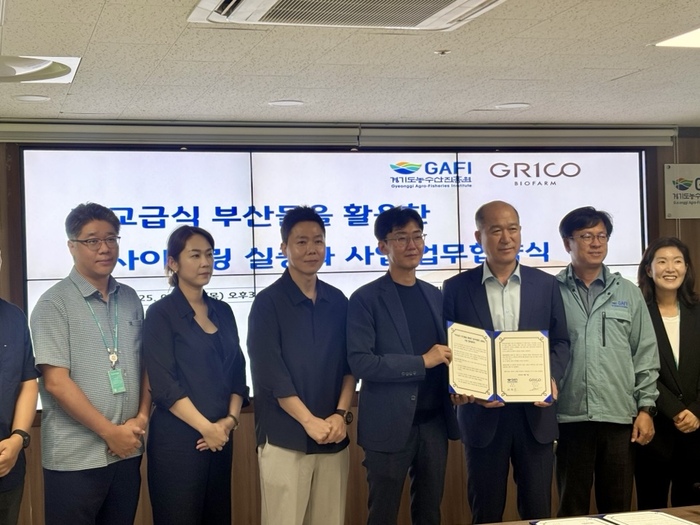
The two organizations signed a Memorandum of Understanding (MOU) on the 7th and announced plans to actively promote the eco-friendly conversion of discarded by-products and the joint development of biodegradable plastic prototypes.
GRICO has been producing household goods and packaging materials using agricultural and marine resources such as surplus grains and discarded seaweed. Through this collaboration, the company will expand its range of raw materials to include school meal by-products.
According to Gyeonggi-do, a total of 1,997 tons of pre-processing by-products were generated from school meal programs in the province last year. In this pilot project, discarded lettuce will be prioritized as the primary raw material for commercialization testing.
▲ Park Jae-min inspecting products at the Rice Farm factory. (Photo = Reporter Ok Ji-hoon)
GRICO will take full responsibility for research and development as well as prototype production aimed at converting by-products into high-value eco-friendly advanced materials. The company plans to develop five types of biodegradable plastic products, including:
During the development process, the company aims to secure product reliability through material property and safety verification, as well as by obtaining Environmental Label Certification (EL724) and approval from the Ministry of Food and Drug Safety.
The final prototypes are scheduled to complete production and verification by December of this year, and the results will be shared along with plans for expansion into the public sector.
In particular, GRICO intends to leverage its technological capabilities to secure both public value and scalability while establishing a stable raw material supply chain and a sustainable business structure.
A representative from GRICO stated,
“Discarded resources such as school meal by-products will be reborn as eco-friendly high-value materials, presenting a practical model for the circular economy. Based on the results of this commercialization project, we also plan to explore applications using other types of by-products.”
The project is being recognized as a resource circulation model encompassing regional waste resource utilization, eco-friendly material development, and the potential for public-sector expansion.
However, industry experts point out that for full commercialization, challenges such as securing raw material stability, ensuring product quality and safety, improving certification procedures, and optimizing cost structures must also be addressed.
— VIP News / Reporter Kang Se-a