
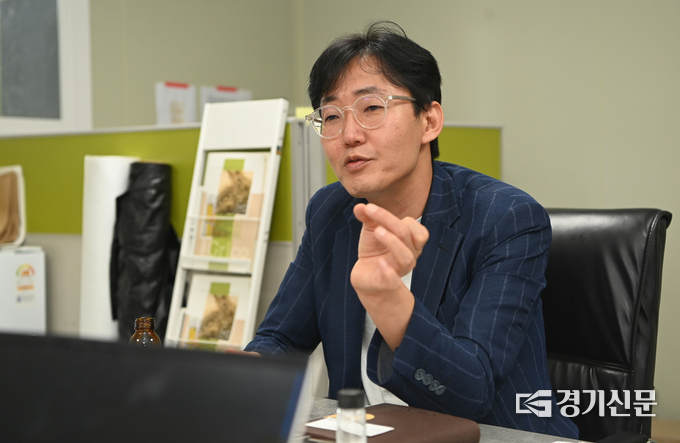
▲ Park Jae-min, CEO of GRICO. (Photo = Reporter Ok Ji-hoon)
When asked whether the global plastic waste problem can be solved, one company confidently answers “yes.” That company is GRICO, a firm leading the development of eco-friendly plastic materials using agricultural and marine waste resources. GRICO creates new value from discarded resources such as surplus grains and waste seaweed, offering solutions for a more sustainable future.
At the center of GRICO is CEO Park Jae-min, who focused on South Korea’s surplus grain disposal issues and marine environmental pollution. To address these challenges and create new industries, he founded GRICO. He explained the company’s founding philosophy as follows:
“I wanted to return valuable plant-based resources obtained from nature back to nature, creating a new eco-friendly future where nature and humans coexist in mutual respect.”
Below is an introduction to GRICO:
GRICO is an eco-friendly plastic materials company established in August last year. Since joining the WTO, South Korea has been required to import more than 400,000 tons of rice annually, resulting in significant costs associated with surplus grain management. In addition, coastal regions face environmental damage and disruption to the fishing industry due to marine invasive species such as Sargassum horneri drifting in from China.
GRICO was founded to address these issues and create a new industry through the upcycling of agricultural and marine resources.
The company also contributes to society by donating a portion of its profits to socially vulnerable groups and child welfare initiatives, positioning itself as an eco-friendly materials company committed to both environmental and social responsibility.
▲ Park Jae-min inspecting products at the Rice Farm factory. (Photo = Reporter Ok Ji-hoon)
In 2019, the idea began with extracting natural oil from surplus rice and grains to produce filler oil. However, after the extraction process, a large amount of by-products remained. Seeing that this process itself was generating another form of waste, I became motivated to solve this issue by developing a new eco-friendly plastic material.
By utilizing low-cost surplus grains, we were able to secure price competitiveness compared to conventional plastics. In addition, since the products are biodegradable, they can contribute to soil enrichment, which aligned well with our company’s mission and philosophy.
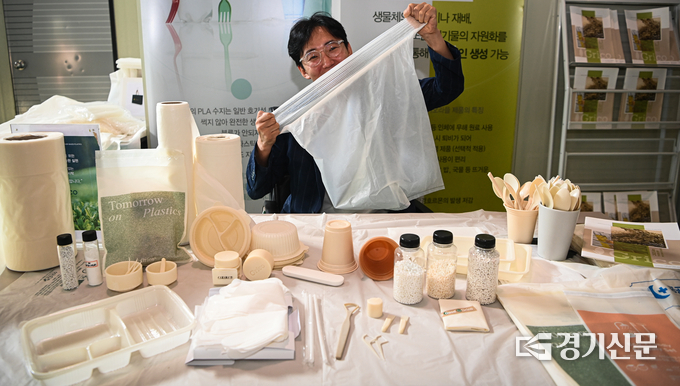
▲ Park Jae-min introducing Styrofoam-like products made from surplus rice. (Photo = Reporter Ok Ji-hoon)
Q. Where and how are GRICO’s products currently being used?
GRICO’s products have been commercialized and are currently used in a wide range of applications, including mulch film, general-purpose bags, table covers, sanitary gloves, and wraps for both daily life and industrial packaging.
Most of the supply is carried out through B2G (business-to-government) channels. Recently, GRICO also signed an agreement with the accommodation platform Yanolja to supply bathroom pouches used in lodging facilities.
▲ Park Jae-min introducing Styrofoam products made from surplus rice. (Photo = Reporter Ok Ji-hoon)
Q. What is the product you are most attached to?
While I have affection for all our products, I am most attached to the Styrofoam-like product made from rice. We created a foam box by naturally foaming waste rice, which can replace conventional EPS packaging materials. It decomposes easily in nature and can even be used as compost, making it environmentally beneficial.
Q. Were there any difficulties in converting various surplus agricultural resources into plastic materials?
Agricultural and marine waste resources posed many challenges in achieving the desired material properties, such as enhancing heat resistance at a low molecular level and combining with polymers to achieve specific performance characteristics. To overcome these issues, more than three years of R&D and significant investment were required.
Q. How do you handle by-products generated during production?
Conventional biodegradable materials often generate residual by-products during extraction, which leads to environmental disposal costs. However, we directly convert agricultural and marine waste into new materials through dehydration, drying, and pulverization processes, allowing us to produce pellets without generating any by-products.
Q. What is your competitive advantage compared to other bio-plastic companies?
GRICO uses agricultural and marine waste resources, giving us several key advantages:
Q. How do you foresee future trends in the plastics industry?
After the upcoming 5th International Plastics Treaty to be held in Busan, we expect conventional chemical plastics to gradually be reduced, while biodegradable and bio-based materials will gain greater attention as alternative solutions. The elimination of microplastics will also become a major global issue.
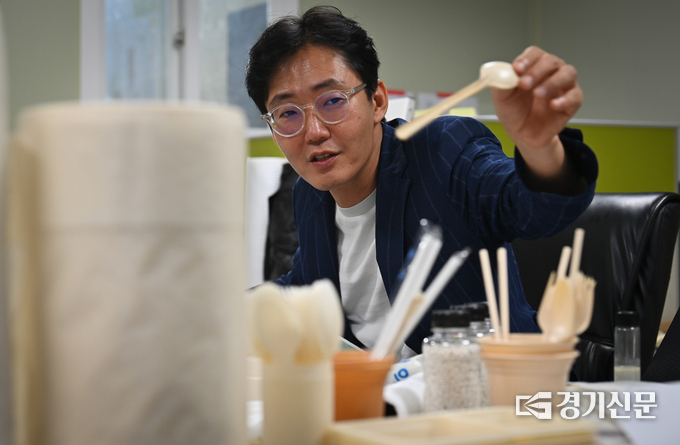
▲ Park Jae-min introducing products of GRICO. (Photo = Reporter Ok Ji-hoon)
GRICO expects that global adoption of its products could transform existing treatment and utilization systems for agricultural and marine waste resources, which are currently often processed as animal feed or disposed of at cost.
In the future, these resources are expected to shift from being treated as environmental waste requiring disposal costs to being upcycled into new eco-friendly advanced materials.
Q. What is GRICO’s goal?
GRICO aims to grow into a global specialized materials company utilizing agricultural and marine waste resources.
Beyond simply producing alternative plastic products, the company seeks to apply eco-friendly materials across various high-value industries, including industrial packaging, nonwoven fabrics, Styrofoam alternatives, and paper products.
Through this, GRICO aims to contribute to reducing carbon emissions and addressing climate change, ultimately expanding its materials and products worldwide so that future generations can enjoy a healthier and more sustainable planet.
— [Gyeonggi Newspaper = Reporter Oh Da-kyung]